

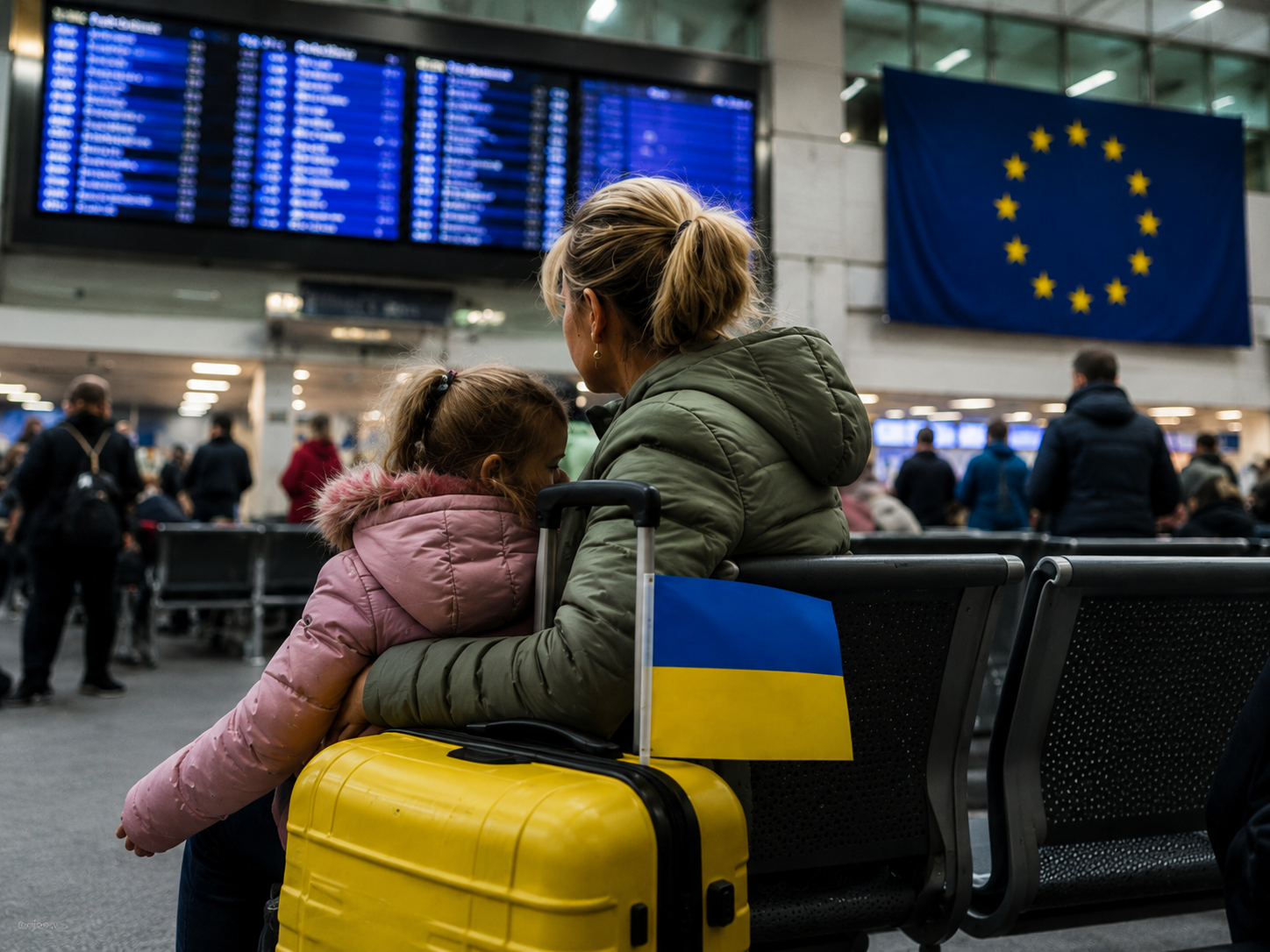
As of the end of June 2026, 4 million 407.68 thousand non-EU nationals who had been forced to leave Ukraine following the start of the full-scale russian invasion were benefiting from temporary protection in European Union countries. Over the month, their number increased by 24.38 thousand people, or 0.6%, according to Eurostat data published on Tuesday.
The largest increase in the number of temporary protection beneficiaries in absolute terms in June was recorded in Italy — by 4,115 people, or 8.8%. In Czechia, the figure rose by 3,835 people (+1.0%), while in Germany it increased by 2,960 (+0.2%).
At the same time, the number of people with this status declined in three EU countries. Poland recorded a decrease of 6,335 people (-0.7%), Belgium of 35 (-0.04%), and Ireland of 15 (-0.01%).
Thus, during June, the number of temporary protection beneficiaries increased in 24 European Union countries, while a decline was recorded in only three.
Compared with June last year, the number of refugees from Ukraine under temporary protection in the EU increased by 95.79 thousand people, corresponding to growth of 2.2%.
Germany remains the leading country in terms of the number of Ukrainian refugees hosted. At the end of June 2026, there were 1 million 286.23 thousand temporary protection beneficiaries in the country, compared with 1 million 196.65 thousand a year earlier. Germany accounts for 29.2% of all such persons in the European Union.
Poland ranks second, with 961.17 thousand people registered, compared with 992.51 thousand a year ago. Its share amounts to 21.8% of the total number of temporary protection beneficiaries in the EU.

Czechia is in third place, with 390.81 thousand people compared with 378.42 thousand a year earlier. The country accounts for 8.9% of all temporary protection beneficiaries.
Next are Spain, with 269.69 thousand registered beneficiaries compared with 239.89 thousand a year ago, and Romania — 215.30 thousand compared with 188.17 thousand.
When population size is taken into account, the highest concentration of temporary protection beneficiaries at the end of June was recorded in Czechia — 35.8 people per thousand inhabitants. In Slovakia, the figure stood at 27.2, while in Cyprus it was 26.8 people per thousand inhabitants. The European Union average was 9.8.
The overwhelming majority of temporary protection beneficiaries in the first half of 2026 were Ukrainian citizens, accounting for more than 98.5% of the total.
Among temporary protection beneficiaries, 43.4% were adult women, 29.6% were children, and 27.0% were adult men.
For comparison, a year earlier women accounted for 44.7%, children for 31.2%, and men for 24.1%. Another year earlier, the respective shares stood at 45.6%, 32.4%, and 22.0%. Thus, in recent years, the proportion of adult men among temporary protection beneficiaries has increased noticeably.
More than 100 thousand people with this status were also living in Slovakia at the end of June — 147.32 thousand compared with 133.21 thousand a year earlier, the Netherlands — 142.21 thousand compared with 125.73 thousand, and Ireland — 120.17 thousand compared with 113.24 thousand.
Between 50 thousand and 100 thousand temporary protection beneficiaries were registered in Belgium — 96.18 thousand compared with 90.71 thousand a year ago, Austria — 90.57 thousand compared with 85.34 thousand, Norway — 86.57 thousand compared with 80.12 thousand, Bulgaria — 74.04 thousand compared with 67.73 thousand, Switzerland — 73.27 thousand compared with 69.02 thousand, Finland — 72.24 thousand compared with 73.06 thousand, Denmark — 51.19 thousand compared with 37.66 thousand, Italy — 51.11 thousand compared with 16.88 thousand, and Lithuania — 50.23 thousand compared with 47.04 thousand.
In France, official statistics indicate 49.34 thousand temporary protection beneficiaries, compared with 55.19 thousand a year earlier. At the same time, French data traditionally largely exclude children.
Fewer than 50 thousand Ukrainian refugees with temporary protection were registered in a number of other European countries. Sweden had 48.73 thousand compared with 44.31 thousand a year earlier, Hungary — 44.97 thousand compared with 40.90 thousand, Greece — 40.98 thousand compared with 36.29 thousand, Latvia — 31.96 thousand compared with 31.93 thousand, Estonia — 30.41 thousand compared with 34.37 thousand, Croatia — 30.00 thousand compared with 27.05 thousand, and Cyprus — 26.75 thousand compared with 24.14 thousand.
In Luxembourg, 3.84 thousand people were benefiting from temporary protection compared with 3.79 thousand a year earlier, in Malta — 2.66 thousand compared with 2.34 thousand, and in Liechtenstein — 0.95 thousand compared with 0.76 thousand.
Eurostat notes that the statistics were compiled on the basis of EU Council Implementing Decision 2022/382 of March 4, 2022. The document officially recognised the existence of a mass influx of displaced persons from Ukraine as a result of the russian military invasion and provided the legal basis for activating the temporary protection mechanism.
On July 31, 2026, the European Council decided to extend temporary protection for displaced persons from Ukraine for another year — from March 4, 2027, until March 4, 2028.
At the same time, EU countries for the first time agreed on a condition under which temporary protection should be granted only to persons fulfilling their military obligations in Ukraine. The restriction is expected to apply exclusively to new applicants seeking this status.
According to the Office of the United Nations High Commissioner for Refugees, as of June 30, 2026, there were 5.159 million Ukrainian refugees in European countries, while their total number worldwide was estimated at 5.687 million.
For comparison, as of April 30, the corresponding figures stood at 5.213 million people in Europe and 5.687 million worldwide.
At the same time, the number of internally displaced persons within Ukraine continues to increase. According to the latest UN data for July 2026, their number reached 3.80 million. In January this year, the figure stood at 3.70 million, while in July 2025 it was 3.34 million.
In its July Inflation Report, the National Bank of Ukraine maintained its estimate of migration outflow from the country last year at around 300 thousand people. Among the reasons, the NBU cited the deterioration of the security situation towards the end of the year, as well as the easing of exit rules for young people.
At the same time, last year’s figure was lower than in 2024, when migration outflow was estimated at approximately 500 thousand people.
For 2026, the National Bank continues to forecast a net population outflow from Ukraine of approximately 200 thousand people. A reversal of the trend is expected from 2027, when net returns could amount to around 100 thousand people. In 2028, the NBU forecasts that this figure could rise to approximately 500 thousand people.
Source: warecho.org (Eurostat data)